My dream is to design and build a brand new type of Bible Study software -- to create a system that not only aids people’s personal devotions, but actually equips and guides them in the proper methodologies of Biblical interpretation. I want to enable everyone – regardless of their stage of spiritual maturity – to take their personal Bible study to a new level of understanding and depth of insight.
This may sound ambitious, and perhaps even unnecessary (given the number of similar products available); but there are a few aspects to my approach that are unique, and – by God’s grace – may be suitable for creating a new paradigm in Bible study software.
1. The first and most important distinctive about the CodeX system is that it will be designed from the inside-out on sound hermeneutical and exegetical principles. These principles will be “hard-coded”, so to speak, into the architecture in such a way that they might facilitate effective & fruitful, inductive Bible study. Rather than being just a “biblical search engine” or a computerized concordance, the system will be designed to offer carefully crafted and contextually relevant guidance, acting in a sense as a “tutor” for those who are novices in Bible study, and as a powerful tool for those who are more seasoned. These foundational principles include:
- Scripture Interprets Scripture. This system will not be a library of digital commentaries, but rather will enable the reader to see at a glance how a given passage relates to all of Scripture. The Bible is an intricately woven fabric: it’s themes and messages are repeated and echoed from beginning to end. Individual words and verses are most fully understood when read in the context of “kindred verses” across all Scripture. The design of the CodeX system will include an indexed collection of these kindred passages. This collection will be produced by culling previously published (and openly available) cross-reference lists, and also by an algorithmic approach that will automatically detect lexical and semantic similarities in the text.
- Concentric Context. Every verse in the Bible is surrounded by concentric rings of context that expand outward from the given focus of study: word, verse, pericope, chapter, book, author, genre, testament, entire Bible, extra-biblical references. While kindred passages (i.e., cross-references) may be found anywhere Scripture, the relevance of those passages to the interpretation of a given verse most often correlates to their contextual proximity to the verse at hand. The CodeX will reinforce this interpretive principle throughout the search and visualization facilities.
- Original Language Architecture. Many modern translations do not offer a word-to-word correspondence with the original text, making accurate word studies difficult. The word-study utilities of the CodeX system will be engineered directly from the original languages, enabling the users to more accurately understand the words of Scripture, without having to know Greek and Hebrew. For example, all word searches will be mapped to the underlying Greek or Hebrew term before performing the query.
- Theological Design Patterns. In software and web development, “design patterns” are standardized, recurring strategies or templates that are used for common coding situations. Like recipes in a chef’s kitchen, they are selected for a given occasion and combined with others to create a masterpiece. The CodeX system will certainly make use of these, but will go further: every graphical, functional, and architectural design decision will be firmly grounded on Biblical and theological principles. No feature will be included simply as “eye candy” but will require Scriptural or pedagogical justification.
- Inductive Bible Study. To gain a true understanding of Scripture one must “look for it as for silver, and search for it as for hidden treasure.” (Prv 2:4) This requires determination and the discipline of “deep reading” to seek the Author’s original intent in every passage. The CodeX system will support such inductive study by providing the facilities to store years of personal notes, observations, questions, and personalized cross references. These insights will be categorized, indexed and iconified.
- Serendipitous Discovery. There comes a moment for all diligent students who, after struggling and wrestling with a difficult or challenging subject for hours or weeks or months, finally reach a moment when the lights suddenly come on and they say “Ahh! Now I understand!” That is “serendipity.” The CodeX Serendipitus is not designed to make Bible study easy. Bible study was never intended to be easy. But, by the grace of God, this system will facilitate a richer, more enlightening, and more fruitful exploration of God’s Word: “that the God of our Lord Jesus Christ, the Father of glory, may give you a spirit of wisdom and of revelation in the knowledge of him” (Eph 1:17)
2. The next distinctive aspect of the CodeX system is that it will harness some of the modern advances in the fields of textual analytics and data visualization that have been refined by recent research in the National Labs and elsewhere. I intend to use my background in this field, applying many of these literary techniques and graphical tools to the study and exploration of Scripture. This effort will include the introduction of interactive visual tools (or “vistas”) such as configurable chronologies (timelines), animated geographic maps, genealogical network graphs (family trees), and topical visualizations, to name just a few. Other, more sophisticated graphical representations of data may also be added in the future, enabling expert users to explore the meaning of the text in new and productive ways.
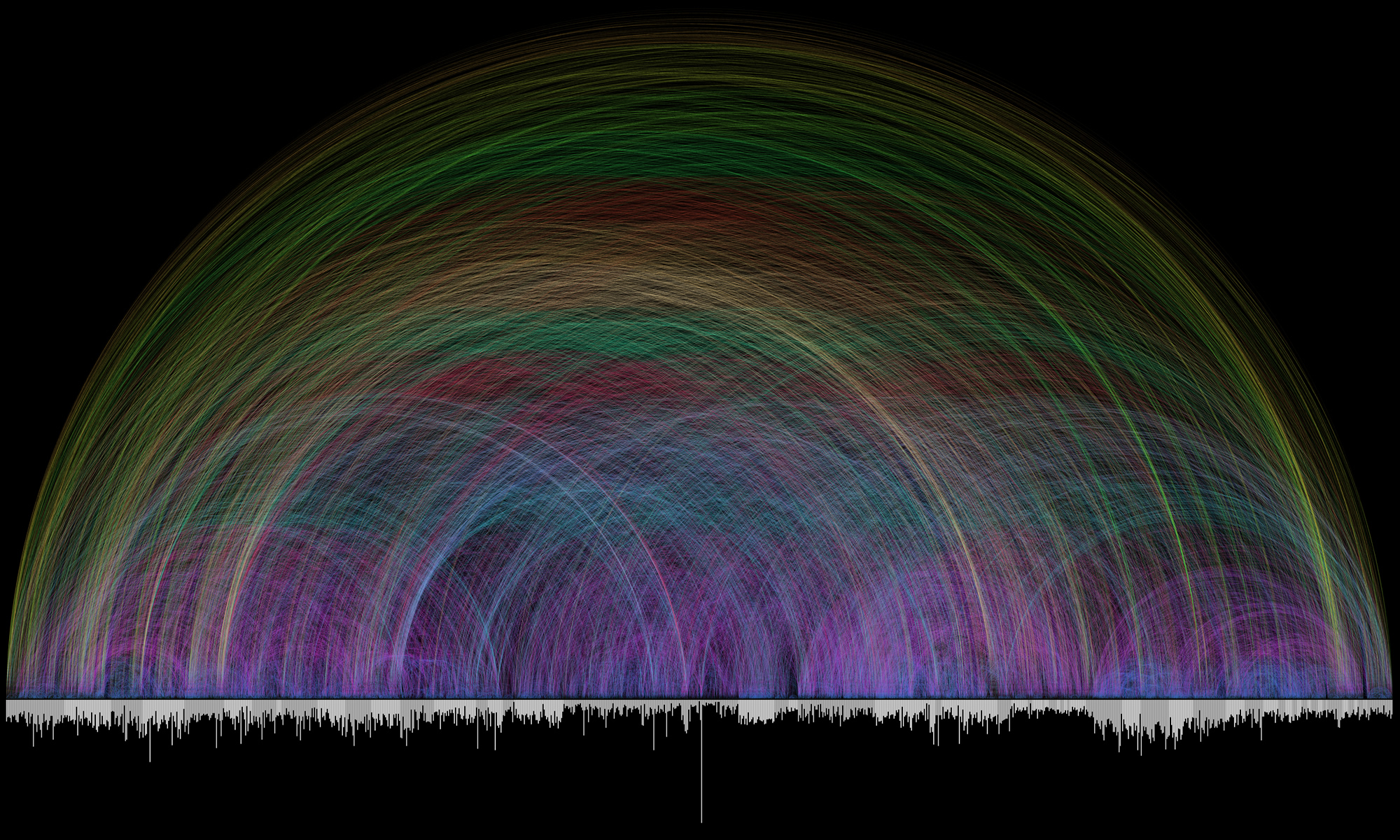
3. Another distinguishing characteristic of this system will be a visual design that is appealing and intuitive and easy to use for people of any age or background. The aim will be to design a system interface that doesn’t draw attention to itself: neither frustrating people with clunky mechanics, nor annoying them with flashy animations. The goal is that this tool will get out of the way and let the user commune with the inspired words. The graphical interface and all the features will be designed in such a way that a user should be able to understand how to use it immediately, and will enjoy returning to it day after day for years. This aesthetic is captured in five words:
- Simple. Intuitive to use and interact with, requiring only a gentle learning curve. It should be something your grandma could use.
- Soft. “Soft on the eyes” – a warm, inviting interface that may someday hold the sentimental charm of a favorite Bible with its dog-eared pages and worn leather cover.
- Sleek. Fluid, fast, and finely-tuned, delivering near-instantaneous navigation and searching.
- Subtle. Uncluttered by glitzy buttons or ponderous menu bars. Everything from the verse numbers to the accompanying visualizations should carefully avoid distracting from the text.
- Spiritual. Painstakingly and artistically crafted – like an exquisite stained glass window bringing glory to God as the light shines through it.
4. One more distinctive of this system is that it will be free (or very inexpensive). This is not a venture to build a fortune on. If the Lord is willing, the CodeX Serendipitus will be made available to every pastor, every missionary, every Bible school student across the land. And then to every elder or deacon or Sunday school teacher, every grandma or grandpa, every disciple of Jesus who is interested in studying the Word of God in a deeper way. Cost should never be a factor in distributing the Holy Scriptures.
----------------------------
My qualifications: My background includes two degrees (Bach/MDiv) in Bible/Theology (Multnomah & Western) and two degrees (Bach/Masters) in Computer Science (WSU), along with roughly ten years of professional experience in both fields. It is my hope that I might finally merge these two life-paths into a new career.

